Posts

Lockdown Paraguay

Image
As with much of the world Paraguay is all but closed for business as the out break of Coronavirus continues to spread. Last week after a second case was reported the government declared that all schools were to shut for 14 days and that all sports, concerts, meetings and other gatherings were to be suspended. Whilst this may sound a little extreme for just a couple of cases the fact is that all but the smallest of out breaks might be too much for the countries healthcare system to cope with. In addition to these measures the countries airports have been virtually shut down and quite possibly restrictions on the land borders are being considered. The current government advice is to stay at home unless you really have to go out and that if you do to keep your distance from everyone else. That distancing runs contrary to the Paraguayan nature where people don't have concerns about personal space, and so always stand close together and are constantly shaking hands and touchin...

Empanadas, Paraguayan street food

Image
Firstly before going any further it must be said that there is nothing particularly Paraguayan about an empanada. These little pasties are in truth a Latin American snack. However in Paraguay at least they are the street food per excellence. In Paraguay they are ubiquitous. For sale freshly cooked in every bar, café and on every street stall in the country. They are simple tasty snacks. A half moon of flaky pastry with an one of several different fillings inside. The traditional cooking method was deep frying which did make the empanada rather greasy and unhealthy. Fortunatly though these days they tend to be cooked with slighly less oil of baked in the oven. Three fillings are always available. These are beef, chicken or cheese and ham. Beef with this being a land of cattle is the most tradicional filling and is mixed with onion and a little egg. Of the other two options I personally find chicken to be a little dry. Cheese and ham however is what I usually opt for, the mel...

On the open road.

Image
Like most cities in the world Asunción has it's problems with traffic. Far too much of it moving far too slowly. However once beyond it's suburbs spaces soon open up and with that a chance to enjoy the view and the ride. I myself living in the countryside that surrounds Piribebuy am far beyond the reach of an congestion with the only things liable to hinder uninterupted passage being a slow moving lorry or a herd of cattle.  Once I have negotiated the dirt track from the house I arrive at empty tarmac stretching off into the distance to both the left and the right.  Turning left I find myself heading towards Piribebuy. First the road dips down passing on one side a school and on the other a couple country parks. Crossing a bridge over a small river just before the second of these there is then a long sweeping climb to the crest of a hill.  From here on the road takes a more purposeful direct route towards Piribebuy. Straight down to a valley bottom and t...

The founding of Asunción

Image
Every year in Paraguay the 15th August is one of the countries largest and most important national holidays. It marks the anniversary of the founding of Asunción. On the 15th August 1537 Juan de Salazar y Espinosa would have been quite unaware that the settlement he was about to found after turning his ship off the River Paraguay and into the Bay of Asunción would grow into the capital of an independent nation and survive as one of the oldest permanent cities in the whole of South America.  The expedition had not left Buenos Aires as a mission of conquest seeking to expand Spanish control further up river, but instead as a search party to find the ship of previous adventurer who had failed to return.  This was Juan de Ayolas who had headed up river to chart and explore the land. He may have been the first Spaniard to see the Bay of Asunción, but his ship was never found, so what he had seen was lost with him.  It was after heading far up stream on his se...

The Paraguayan flag

Image
The flag of Paraguay as any school child in the land will tell you is red, white and blue. Beyond that though it is also unique in the world in that it is different on both sides and is also one of the oldest. The design of the flag with it's three horizontal stripes is believed to be based on either the French or Dutch flags and has been in continuous use since November 1842. The flag itself was designed during the rule of Paraguay's first post colonial leader Jose Gaspar Rodríguez de Francia. He was head of state from 1814 until 1840. However it was not until a couple of years after his death that the flag as seen today became that of Paraguay.  The three stripes as with all flags are not merely decoration but each hold their own meaning.  The red stripe at along the top of the flag stands for courage, equality and patriotism.  Next the white stripe across the middle of the flag stands for unity, purity and peace.  Then finally the blue st...

Always another sunset

Image
One of the many joys of living where I do is the knowledge that unless there is cloud and rain the sunset will be glorious. With rains coming just occasionally that means most days. My home is in the countryside in one of the outlying districts of the little town of Piribebuy. As such I am surrounded by unbroken green countryside. In three directions the view extends to the horizon and on the fourth, the north, it is interupted not by buildings but by a range of tree covered hills. All this open space brings with it clean clear air through which the colours of nature can shine without obstruction. Each evening as the sun slowly sinks below the palm trees to the east the sky is a festival of colours. Throughout the year the sun slowly moves to the north and south but never behind anything artificial or man made on the horizon. The quality, colour and duration of the show vary according to the clearness of the air and the clouds in the sky. The very best sunsets are produced wh...

Atmospheric Phenomenon

Image
I was recently treated to a sight unlike I had ever seen before. A rare atmospheric phenomenon called a solar halo. My first inlination that something was going on was when I stepped outside to find a huge black disc just hanging in the air above the house. Anyone who has seen the film Independence Day and remembers the mother ship hanging silently over the White House should be able to picture the sight that greeted me. And large it certainly was. The more accurate name for this type of solar halo is a 22 degree halo, after the portion of the sky it covers. The halo takes the form of a circular ring of bright light some distance from the sun. Then between this ring and the sun is a dark disc, almost as dark as the night sky. Inside everything at the very center is the brightly glowing sky. The halo was made even more distinct by the rest of the sky remaining a brilliant cloudless blue. And in addition although the dark disc covered a large portion of the sky it cast no shado...

Mandioca, the Paraguayan staple

Image
Manihot Esculenta as it is known amongst scientists is a central part of every Paraguayan meal. Here it is known as mandioca or manioc and a dish without a side plate filled with it would be incomplete. In English mandioca is know as cassava and it is a New World root tuber related to the yam and potato. Like them is has a very high starch content and is a mayor source of carbohydrates. Mandioca was one of the first crops to be domesicated. This was initially occured in the Amazon basin at some point before 5000BC. From there it's cultivation spread across the tropical and sub tropical Americas before travelling over the past few hundred years through trade and conquest across Africa and Asia where it has also become an important source of carbohydrates. The plant itself with the addition of heat is very easily grown and being drought resistant tolerates the most marginal of conditions. Sewing of mandioca requires nothing more tossing a small fragment of it's woody stem...

Beyond the tarmac

Image
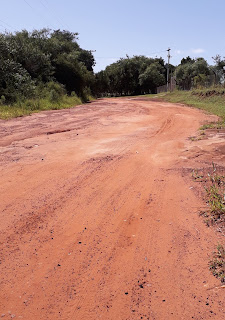
Most of the roads between towns and across the country in Paraguay have now been paved. The same is true of the principal roads around the towns and cities, however it does not take long, even in Asunción to find an alternative road surface. Firstly on those roads concidered not quite important or pricipal enough to receive a coating of black tarmac the suface is often cobbles. These rough uneven stones must be one of the worst surfaces for driving upon. Unless approached slowly and with great caution travelling across them is a truely bone shaking experience. Fortunatly they are on the whole used only as a coating for roads around towns and can normally be exited within a block or two. The laying of cobbles does though make sense for councils as uncomfortable as they may be they are as permanemt as tarmac so not requiring regular repairs. Also these tend to be the roads earmarked for tarmacing as the fully paved network slowly expands. Once beyond the cobbles though things q...

Supermarkets

Image
When I first arrived in Paraguay supermarkets were a common sight in Asunción but few and far between in the rest of the country. This has changed completely in the years that I have lived here. As I mentioned, years ago when I first came to Paraguay supermarkets were very much an Asunción thing. Apart from a few independent stores the trade was very much controlled by as small number of brands such as Stock and España. Beyond the reach of Asunción trade was still in the hands of independent businesses which operated on every high street in the form they had always done. Each with it's own range of produce and opening hours. This was also a time before self service stores when inefficiency and over staffing were the order of the day as each member of the extended household had to be given something to do. On the whole these were old fashioned stores with a shop counter and behind that, where the customer could never tread the stock. To buy something could be a complicat...

Back to school

Image
After the long, long summer holiday it is finally time for the schools to open their doors once more. Locally they actually reopened last Friday, but Monday is a far more sensible day for the children to begin their new school year. As always in Paraguay due to the high temperatures during the summer the school holidays are always several months long. The last school year ended mid November and this new one is beginning three months later in late February. During the holidays the schools all became overgrown and untidy. So over the past couple of weeks have slowly been brought back to life with buildings being cleaned and swept and grass being cut to ensure they were ready for the arrival of the children. After the long break the children are all looking forwards to catching up with their friends and seeing once more their teachers. No doubt also more than a few households are glad that the children have once more got something to do to fill their days. However the classes wi...

The first cool spell of the year

Image
Whist winter is still several months away and it would be quite an exaggeration to call it cold the weather now is very different from that of just a couple of days ago. Summer here is a long hot season and although it is a time of great pleasure by mid February everyone has had quite enough of being baked and is looking forward to some cooler days. The first of these cool snaps usually arrives in late February. With this one being forecast for a few days now the change in the weather has become one of the main topics of conversation here abouts. Second only to the start of the new school year. The change when it arrived was sudden. One day hot, sweaty and nearly 40 degrees and the next barely above 20 with the air now very dry. As always the cold weather arrived from the south. A strong wind blowing off the South Atlantic, across the Argentine Pampas and then onwards to Paraguay by which time it had lost all it's moisture. Weather fronts arriving in this way are why Para...

A day in the English school

Image
The days started early in our English school in Naranjo, Piribebuy. At first light a strong bright sun burst into life. If that was not enough to waken everybody in their tents and huts then the sound of the chickens getting going for the day certainly was. Once outside a quick wash to open the eyes and a queue for the toilet and all were soon ready for the day ahead. First stop the kitchen to light a fire to boil some water for the morning drink. Coffee, or if someone felt adventurous, cocido, Paraguayan style. That done we had then a little time to sit and enjoy breakfast. Also the ideal time to remember where today's props and lesson plans were and to chat through who was teaching who before the children started to arrive. That happened very soon after breakast as with schools starting early the children are used to getting going in the morning. They came from throughout the surrounding area. Some walking half an hour to be taught a little English. The children gradu...

The Cocotero or Coco Paraguayo

Image
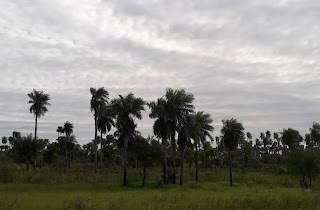
The cocotero is the ubiquitous tree of Paraguay. There may be more graceful trees and there may be trees with more edible fruits but it is the tree many think of first when describing Paraguayan trees. No scene or image of Paraguay would be complete without one and outside of Asunción it is hard to look anywhere without spotting one. Even one of the junior school text books is named after the cocotero. It is a type of palm found throughout South America but it's commonness in Paraguay in particular has aquired for it the name Coco Paraguayo. Across it's range there are several local names but there is agreed common name and no name at all in English. There the only title available is it's scientific name of Acrocomia Aculeata. Needless to say I have never heard one refered to as such. As with with all palms it has a straight fiberous trunk which can grow to in excess of 20 metres. Being a palm there are no branches just a mass of fronds sprouting from it's summi...

Paraguay. A green land.

Image
Despite the inevitable illegal logging and forest fires Paraguay remains a very green and heavily wooded land.  Even where the trees have been cleared they are on the whole replaced by pasture rather than concrete. The picture is a little different in the thorn bush srub of the Chaco in the north west, but the image of a green and fertile land holds true for the rest of the country. Even Asunción, by far the biggest city in the country has plenty of green spaces. There are large plazas full of mature trees, shady trees lining the sidewalks and several large city parks. The largest of these are the Botanical Gardens a little way from the center and Park Nu Guazu on the road towards the airport. All this greenery makes Asunción a pleasant place to walk around even in high summer. The parks and plazas are popular places to relax and recharge away from the bustle of the city. Heading away from Asunción and into the interior the surroundings become still greener. Travelling on...